

With Parliament approving the general principles of the 2026-27 Budget Bill in its Stage 1 debate last week, the Government’s spending plans for the next financial year are on track to be approved later this month.
But what about spending beyond next year?
Alongside the detailed budget plans for 2026-27 published on 13 January this year, the Scottish Government also set out medium term spending priorities in its Scottish Spending Review document.
This presented spending plans through to 2028-29 for resource (or day-to-day spending on things like public sector pay and running public services) and through to 2029-30 for capital spending (on things like building and maintaining public infrastructure like schools, hospitals and roads).
Multi-year spending plans are not set-in-stone and the next Parliament will consider a Budget Bill for each financial year in turn. The funding position will change based on future forecasts from ourselves and the Office for Budget Responsibility (OBR) and future shifts in UK Government spending plans which feed through to the Scottish Budget via the Block Grant. The spending allocations may also change following the May election result
The Cabinet Secretary made this point at a recent meeting of the Finance and Public Administration Committee when she said:
“The spending review is for planning purposes, but, in the course of history, the figures in a spending review have never remained at the same level.”
Nevertheless, Spending Reviews are a very helpful indicator of priorities. So what did the Scottish Spending Review tell us about the current government’s priorities?
This Insight considers the resource budget – which covers day-to-spending.
Three portfolios make up 80 per cent of day-to-day spending
Figure 1 below shows that the three portfolios of Health and Social Care, Local Government and Social Justice account for £4 of every £5 to be spent on day-to-day spending next year.
Figure 1: Portfolio Budget share for day-to-day spending, 2026-27
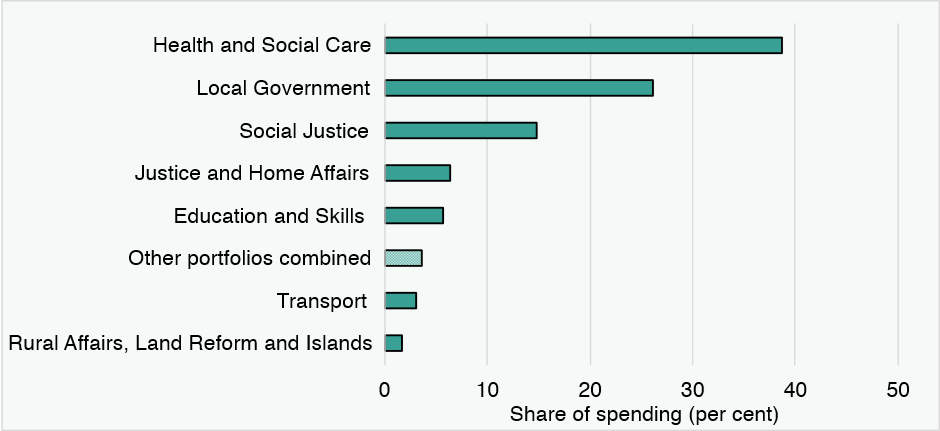
However, the outlook presented for these three largest portfolios in the Scottish Government’s Spending Review differs. While Health and Social Care and Social Justice (which includes Social Security spending) will increase as a share of total day-to-day spending over the Spending Review years, Local Government will see its share fall. The Spending Review trajectory for these three portfolios is presented in Figure 2.
In summary:
- Health and Social care increases its share from 38.7 per cent in 2026-27 to 40.0 per cent in 2028-29.
- Social Justice increases its share from 14.8 per cent in 2026-27 to 15.5 per cent in 2028-29.
- Local government’s share of day-to-day spending presented in the Spending Review falls from 26.1 per cent in 2026-27 to 24.8 per cent in 2028-29.
Figure 2: Percentage share of day-to-day spending by portfolio
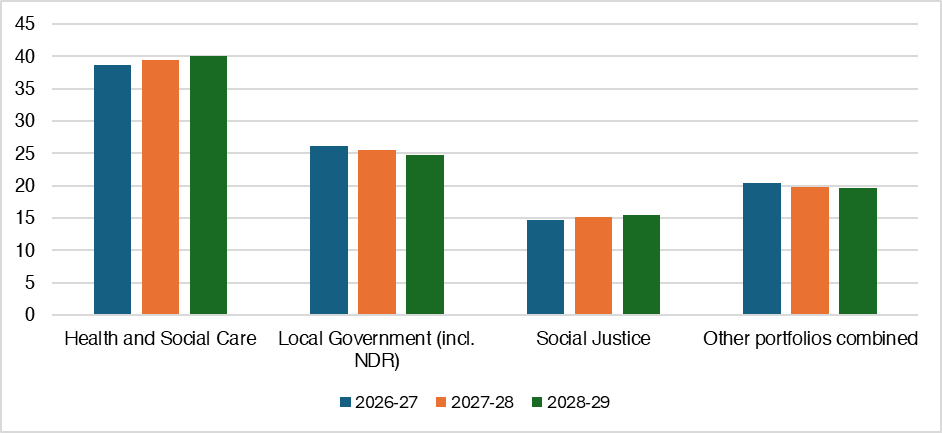
Figure 2 also shows spending allocations for all ‘other’ portfolio budgets outside the ‘big 3’ – essentially all other parts of the Budget which make up the remaining £1 in every £5.
Like Local Government, these ‘other’ portfolios are set to fall as a share of day-to-day spending set out in the Spending Review. These other portfolios combined will fall as a share of resource spending from 20.5 per cent in 2026-27 to 19.7 per cent in 2028-29.
Tough Budget choices ahead
Given the demographic outlook faced by Scotland and set out in our work on fiscal sustainability, as Scotland’s population lives longer and ages, demands on health services are ever growing. Figure 3 shows that other than for children under five, health spending increases with age.
Figure 3: Resource health spending by age in Scotland, 2029-30
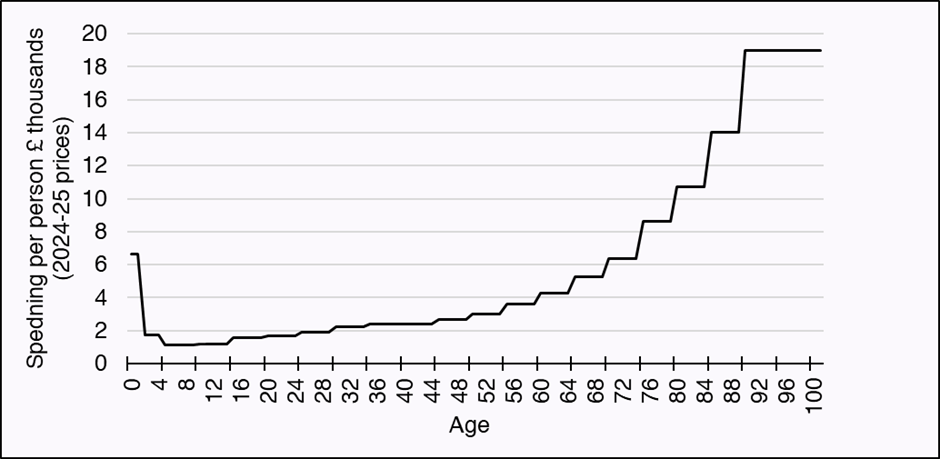
However, in a world of finite resources, prioritising spending on health means other parts of spending inevitably get squeezed or taxation must increase.
If additional funding beyond that allocated in the Spending Review, becomes available, there will be a long list of calls on that resource.