
In our latest Fiscal Sustainability Perspectives report, we discussed the increases in the share of the population reporting having a disability, this is known as disability prevalence. Increasing numbers of people have received disability support payments in the last 5 years in Scotland and the rest of the UK.
Between 2020-21 and 2023-24, the disability prevalence for children in Scotland rose from 6 per cent to 12 per cent, while the percentage 16-64 year olds rose from 19 per cent to 28 per cent.
The exact reasons for the rise in the disability prevalence rate are not yet fully understood. It is generally believed to reflect a decline in the overall health of the population which began even before the pandemic, along with increased awareness of disabilities. A further factor could be the on-going health impacts of the COVID-19 pandemic as well as the cost-of-living crisis. As a result, more people may now be eligible for, and apply for, disability support payments.
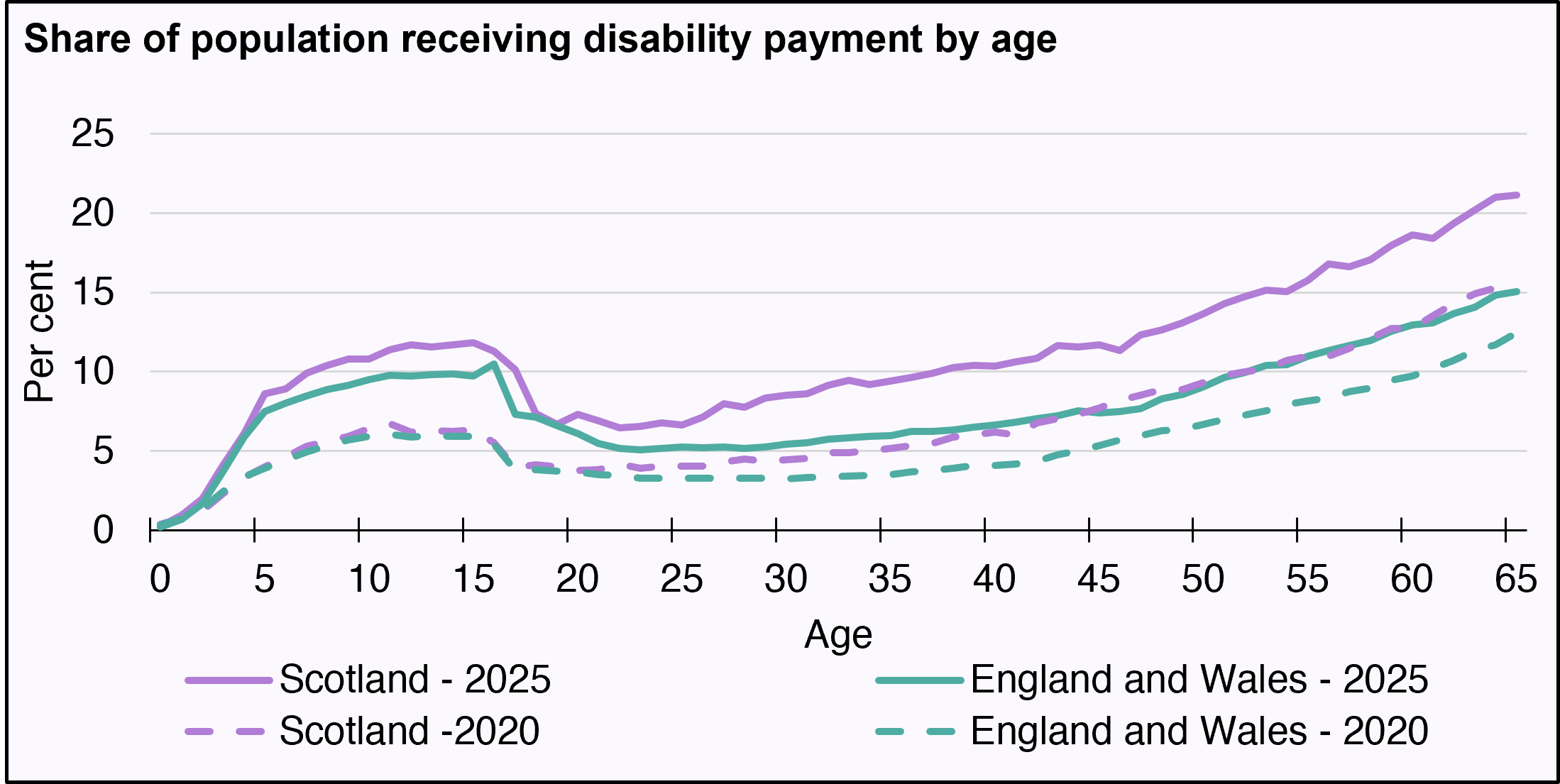
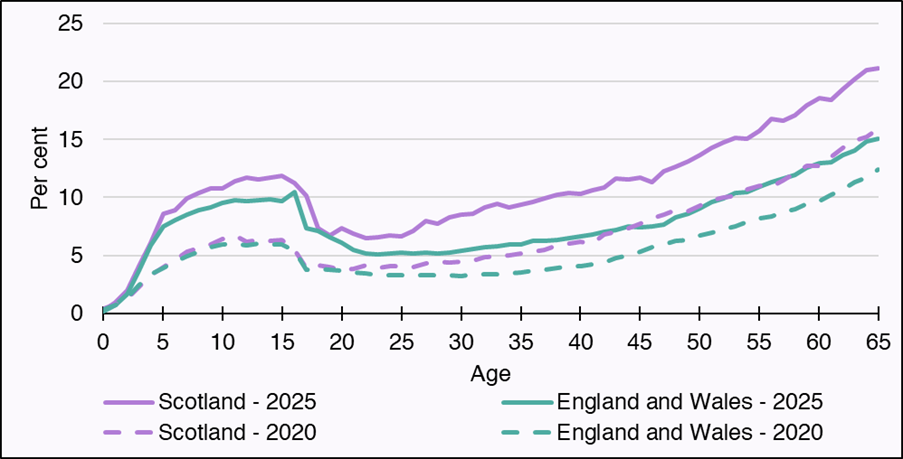
Figure 1: Percentage of population receiving disability payments in Scotland and England and Wales by single year of age in 2020 and 2025
The rate of people receiving disability payments has increased across all ages between 2020 and 2025, but has increased more in Scotland than in England and Wales
Source: Scottish Fiscal Commission.
This rise in the number of people receiving disability support payments is seen across the whole of the UK. Figure 1 shows the increase in the percentage of people of each age receiving disability payments in Scotland, England, and Wales between 2020 and 2025. Although the percentage has risen across the UK, the increase has been greater in Scotland. We have only included the percentage of people aged below 65 receiving disability support payments because the differences are more apparent.
We believe the larger increase in Scotland is partly due to the introduction of the Child Disability Payment (CDP) in 2021 and Adult Disability Payment (ADP) in 2022. When these payments were launched, the Scottish Government introduced operational and delivery changes to promote the payments, support applicants and improve their experience.
Children
The rise is particularly clear among younger age groups. In 2020, the percentages of children receiving Disability Living Allowance (DLA) in Scotland and in England and Wales were very similar. However, by 2025, the percentage of children receiving disability payments in Scotland exceeds that in England and Wales.
In Scotland, the increase in children receiving payments has been across all conditions. Three-quarters of children receiving support do so for mental or behavioural conditions and the number of children receiving payments for these conditions has risen from approximately 30,000 in 2020-21 to 65,000 in 2024-25.
Working age
The percentage of working‑age adults receiving Personal Independence Payment (PIP), ADP or DLA was already higher in Scotland than in England and Wales in 2020, reflecting the higher reported disability prevalence in Scotland. This percentage has since risen by more in Scotland.
In the five years since 2020, there has been a rise in ADP applications from younger people. Analysis indicates a shift in the age profile of applicants. While most new applicants are still over 45, younger adults now account for a larger share than before the pandemic.
In Scotland, around three-quarters of children receiving CDP go onto successfully apply for ADP at age 16. Therefore, the increase in children receiving disability payments is likely to lead to a rise in the number of young people receiving working-age disability payments, with many continuing to receive support into adulthood.
Additionally, data on award reviews for those of working-age show that people are now less likely to lose their award at review than they were four years ago. As a result, people tend to remain on disability payments for longer. This pattern holds across the UK, though the rate at which people exit payments after a review is lower in Scotland than in England and Wales.
Trends set to continue in the next parliamentary session
As more people have been receiving disability payments, we expect these trends to continue, and we forecast that the total number of people receiving disability payments in Scotland will exceed one million by 2030-31.
Funding disability support payments, and the implications for other parts of the Scottish Budget will be a key item in the new Scottish Government’s in-tray following the May election.