
Devolved social security payments will be uprated in April
Earlier this month, Parliament agreed the rates for devolved social security payments in 2026-27. These payments are increased each year to account for price inflation. Parliament agreed that from April most payments will be increased by 3.8 percent, the rate of inflation in September 2025.
This Insight looks at how the annual increases in payment rates (known as ‘uprating’) affect our forecasts of devolved social security spending, and how uprating in England and Wales indirectly affects the Scottish Government’s funding.
Increases in payment rates in 2026-27 account for £0.25 billion of social security spending in 2026-27, increasing to £1 billion in 2030-31
Nearly all the devolved social security spending we forecast is uprated. For every percentage point of inflation our spending forecast will increase by roughly 1 per cent.
The 3.8 percent uprating for April will increase social security spending in 2026-27 by around £250 million. We included this in our January 2026 forecasts, where we forecast devolved social security spending of £7.4 billion in 2026-27.
Beyond 2026-27, we assume all payments continue to be uprated in line with forecast inflation. Our forecasts are in line with the Office for Budget Responsibility’s (OBR) November 2025 inflation forecast, which assumes inflation of around 2 per cent each year. If social security benefits are not uprated in line with inflation, this will put additional pressure on benefit recipients as living costs rise. There is a cost to uprating of course. Spending on devolved benefits in 2030-21 is forecast to be around £1.0 billion higher than it would be if benefit rates were frozen at 2025-26 levels.
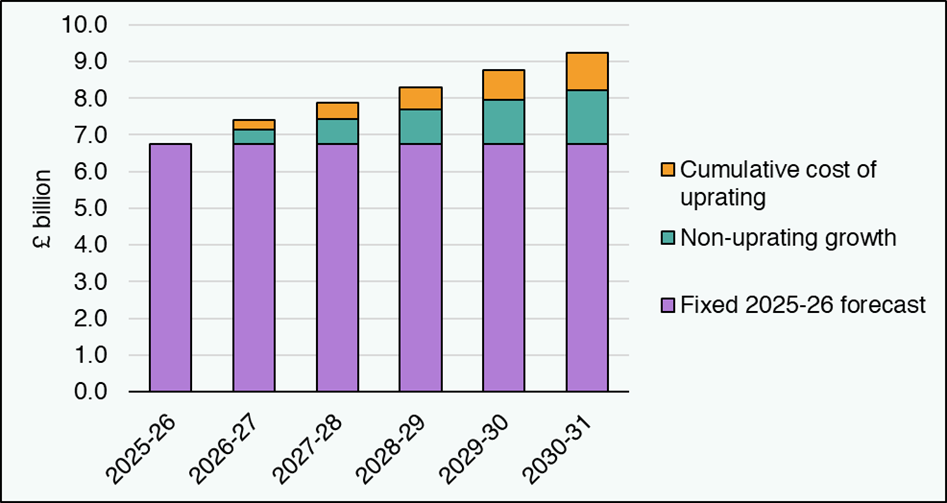
Figure 1 shows how uprating contributes to the growth in social security spending relative to 2025-26, but it also shows that even without uprating, we would still expect spending to rise, mainly due to increasing numbers of people receiving disability payments. This is discussed in our recent Insight article on the increasing rate of disability prevalence in Scotland.
Figure 1: Effect of uprating on social security forecast
Block Grant Adjustment funding also increases with inflation, and covers around 85 per cent of the costs of uprating
The Scottish Government receives funding for the social security payments which have been devolved through the Block Grant Adjustments (BGAs). These are based on how much is spent on disability, carer and winter benefits in England and Wales. Most of these benefits are usually uprated by the same amount as their devolved Scottish replacements. This means that when UK payments are uprated in line with inflation there will be a similar increase in the corresponding Block Grant Adjustments.
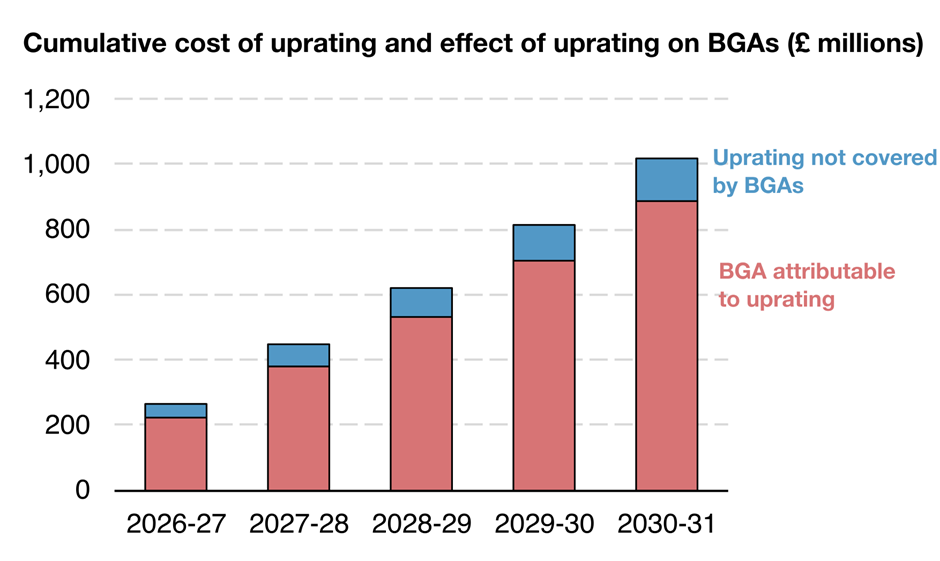
Figure 2 shows that most – around 85 per cent – of the cumulative cost of uprating is matched by growth in the BGAs that is because of uprating of benefits in England and Wales.
Figure 2: Cumulative cost of uprating and effect of uprating on BGAs
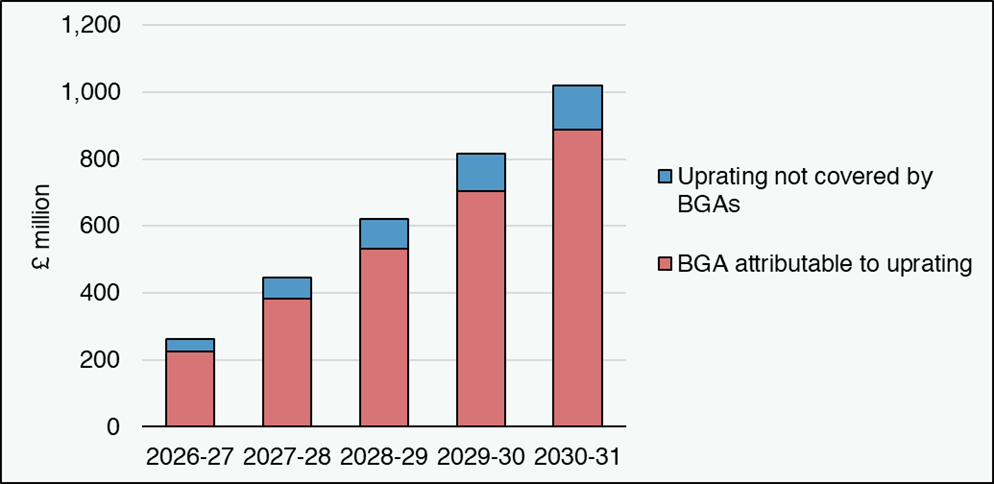
The numbers behind Figure 2 were published with our January 2026 forecasts as supplementary figure S5.14.
The Scottish Government must then find the money for the other 15 per cent
There are three main areas where the Scottish Government has to find funds from other parts of the budget to cover uprating over and above the Block Grant Adjustments:
- Costs of uprating for payments unique to Scotland, where the Scottish Child Payment is the largest element.
- Costs of uprating of Winter Heating Payment and Pension Age Winter Heating Payment, where the equivalent Winter Fuel Payments and Cold Weather Payments in England and Wales are not uprated.
- A share of the costs of uprating for disability and carer payments, roughly in proportion to the extent to which spending on the devolved payments has grown faster than their equivalents in England and Wales.
In our current forecast, these cost £39 million in 2026-27 rising to £131 million in 2030-31.
Is higher inflation back?
Recent events in the middle east and their knock-on effect on oil and gas prices have put inflation firmly back on the agenda.
The potential effects of higher inflation on the Scottish Budget are still highly uncertain and complex. There could be increased costs from uprating benefits, but the BGA funding mechanism discussed above means that most of the social security costs would be matched by higher funding from the UK government.
In other areas we have discussed in recent insights there would be funding and spending implications. For example, higher inflation might result in demands for higher public sector pay, which might be offset by increased tax revenues from ‘fiscal drag’ effects discussed in our Insight last month.
Inflation will be something we at the Commission will be keeping an eye on in the coming weeks and months. We’ll update on the fiscal implications in our August Fiscal Update.