

Much discussion around the Budget centres on ‘resource’ or day-to-day spending for running public services. But what about the ‘capital’ side of the Budget for infrastructure investments in long-term assets like roads, schools and hospitals?
Investing in infrastructure is important for economic growth and the provision of public services. This Insight explains why, and summarises the trends and outlook for capital funding.
Government investment in capital supports economic growth and productivity
In 2025-26 over £7 billion was allocated for capital investment; this was 12 per cent of the Scottish Budget.
Capital spending is different to resource spending which supports the day-to-day costs of running public services. For example, the construction of a new hospital is classed as capital spending whilst the cost of staffing, training and general administration for that hospital is counted as day‑to‑day spending.
Capital investment has important implications for the delivery of public services, economic growth, productivity, and fiscal sustainability:
- In the short-term, capital spending can boost economic growth. For example, building a new hospital or school creates jobs in the construction sector, which can raise household incomes and household spending.
- In the longer term, public capital investment can raise the productivity of both existing public and private capital. For example, improved road infrastructure can reduce transport costs for private businesses, while also improving efficiency of public services such as emergency services.
More broadly, by creating and improving public infrastructure, capital investment has wider effects on economic growth. Better infrastructure allows more people to access the labour market through improved transport networks, improving access to education, health care and leisure.
This Insight focuses on infrastructure investment, but capital spending can also cover upgrades and repairs to existing infrastructure.
Infrastructure spending has faced several challenges
In recent years capital projects have faced challenges for several reasons. For example, there have been pressures on global supply chains following the COVID-19 pandemic and the Russian invasion of Ukraine in early 2022. There have been labour market shortages adding to delays and costs of materials and wages have increased significantly. It remains to be seen what impacts the current volatility in the middle east has on global supply chains and energy prices.
These challenges have meant that construction inflation has been higher than economy wide inflation in recent years, and that capital funding is able to deliver less than would be the case in a lower inflation environment.
For example, in 2023, Audit Scotland noted that around half the projects in the 2021 Infrastructure Investment Plan had been affected by cost increases or delays.
What is the outlook for infrastructure investment in the next parliament?
Infrastructure spending increases this year and next and then falls after adjusting for inflation
Figure 1 below shows that capital funding is expected to decline over the next Scottish parliamentary term in real terms (as measured by the conventional economy-wide “GDP deflator” measure of inflation). As mentioned above, while construction inflation remains high, the capital outlook is likely to be even tougher than these real terms figures imply.
Figure 1: Capital funding outlook
Capital funding grows in 2026‑27 but remains flat in later years and is falling in real terms
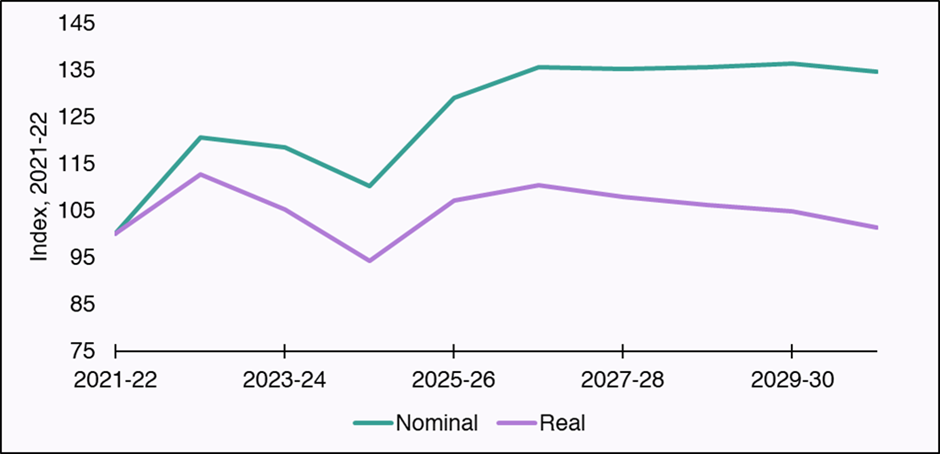
In the Budget just passed by the Scottish Parliament for 2026-27, £7.6 billion is allocated for capital spending. Of this, 93.5 per cent comes from UK Government funding, with the remainder coming from other sources like capital borrowing.
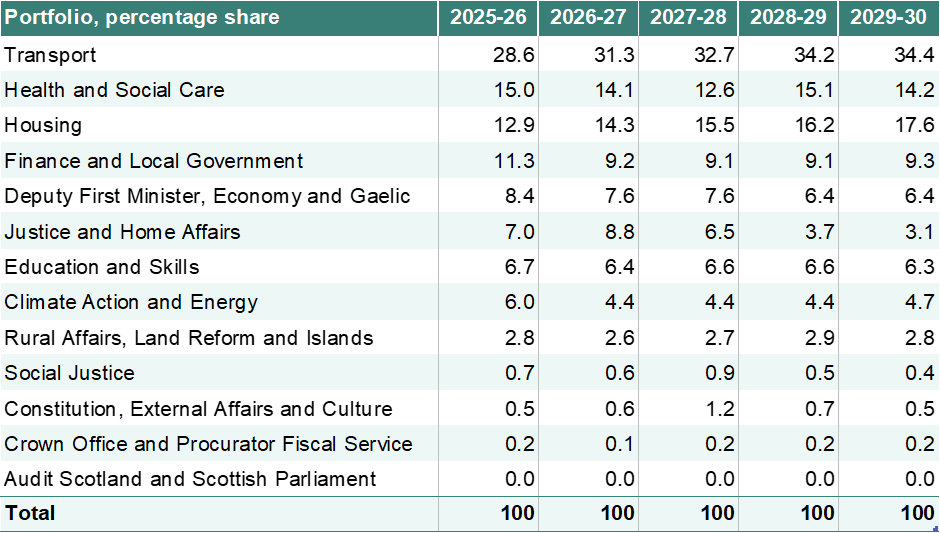
These funds are then allocated across the different Scottish Government portfolios. On a sector‑by‑sector basis, large infrastructure projects can have an impact on overall trends across portfolios which can rise and fall as projects begin and end. Some portfolios may see a large project every few years, which leads to peaks of investment, rather than a regular stream of capital spending. Capital spending will then fall back in future years as the projects are completed.
This dynamic is shown in figure 2 which presents the Scottish Government’s Spending Review portfolio allocations by year and percentage share. For example, capital spending on Justice and Home Affairs increases and then reduces as a share of capital spending as two new prisons are completed. There are similar fluctuations in the Health and Social Care portfolio as hospitals are built at Monklands, Fort William and Barra.
Figure 2: Capital spending by portfolios as a share of total capital spending
The next Scottish Government will face competing demands on the capital budget
In January 2026 the Scottish Government published a Scottish Spending Review, which includes capital spending, an Infrastructure Delivery Pipeline and a draft Infrastructure Strategy. The Infrastructure Delivery Pipeline sets out the major capital projects which the Scottish Government is planning to deliver between April 2026 to March 2030. As mentioned above, decisions on the capital budget also have to take into account the need for upgrades and repairs to existing infrastructure and the cost of new equipment.
It will be for the new administration to set out the next parliament’s priorities, but there is little doubt there will be difficult decisions and trade‑offs in the capital budget.