
When the Scottish Government published its Scottish Spending Review in January 2026, the plans assumed government portfolios would achieve efficiency savings of £1.5 billion over the three years 2026-27 to 2028-29. This included savings of £563 million this year (2026-27).
Included within these plans, is the Scottish Government objective to reduce the size of the public sector workforce, with a target to decrease it by an average of 0.5 per cent each year between 2025-26 to 2029-30.
This Insight identifies some of the key aspects of the efficiency and workforce plans, summarises the latest information on progress, and highlights where further updates on progress would help improve transparency.
Efficiency plans
Alongside the Scottish Spending Review in January 2026, the Scottish Government published planned savings measures for each portfolio. The level of detail varied across portfolios. Some measures were outlined six months before in the Fiscal Sustainability Delivery Plan and in the Public Service Reform Strategy. The Scottish Spending Review translated the proposals into specific spending allocations. Figure 1 below shows that these were largest in the current financial year, 2026-27, with smaller savings expected in later years.
Figure 1: Efficiency savings factored into spending plans
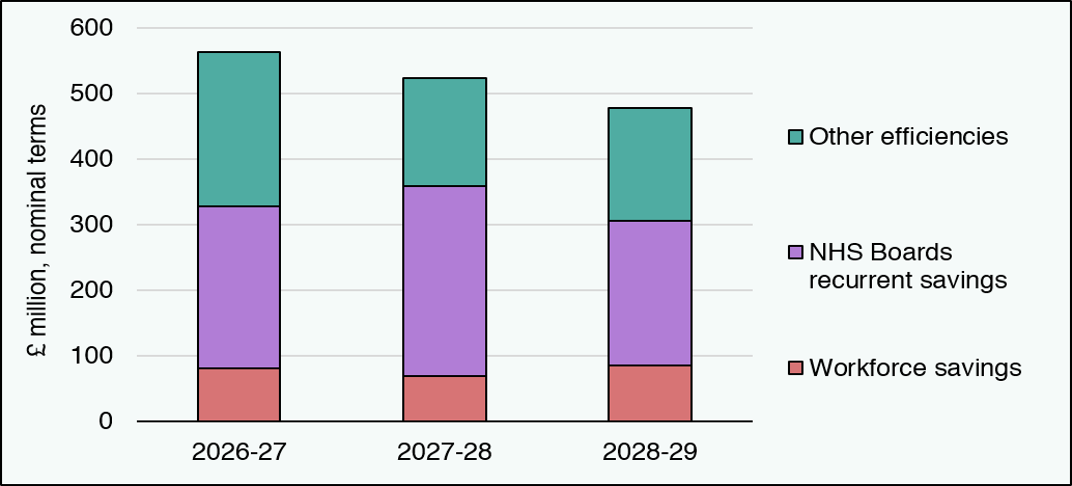
Almost half of the efficiency savings planned over the Spending Review period are expected to come from NHS boards achieving recurrent savings of around 3 per cent each year. We noted in our Fiscal Update that historical performance raises questions about whether these savings can be achieved. Recent evidence from Audit Scotland reports that only 15 per cent of territorial boards and 37.5 per cent of special boards delivered these savings in 2024-25, while many boards continued to require substantial additional financial support during the year from the Scottish Government to balance budgets.
The Scottish Government has not yet reported on the progress made towards achieving these savings. Announcements in the recent Programme for Government included major reform to Health Boards, structural changes and reforms to public bodies and discussions about the future of local government. More information will need to be shared about the financial impact of these changes, including up-front costs and the size and timing of any expected savings. Updates on progress in 2026-27 should be provided by the Scottish Government, and the Scottish Budget in December should set out the plans for future years.
Figure 1 shows that around 15 per cent of the planned savings were to come from workforce savings, and we turn to that next.
Workforce
The Scottish Government plans to reduce the devolved public sector workforce in Scotland by 0.5 per cent a year on average from 2025-26 to 2029-30. These plans were set out in the Fiscal Sustainability Delivery Plan which presented measures to close the fiscal gap identified by the Scottish Government in its 2025 Medium-Term Financial Strategy.
In our February report on what Scotland’s finances mean for the next parliament, we noted that reducing the size of the public sector workforce would require the reversing of devolved era workforce trends.
Figure 2: The growing devolved public sector workforce since 1999
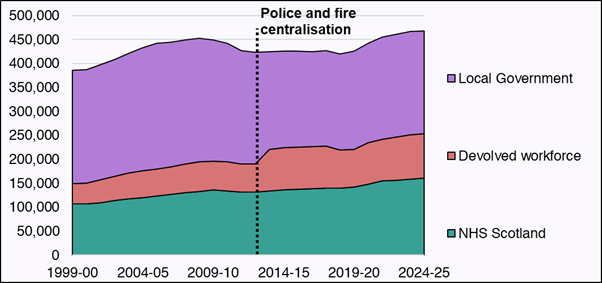
We now have 2025-26 workforce data which covers the first year of the Scottish Government’s stated target of 0.5 per cent reduction on average (between 2025-26 to 2029-30). Figure 3 shows that rather than falling, the devolved public sector workforce has grown over 2025-26.
Figure 3: 2025-26 devolved public sector workforce
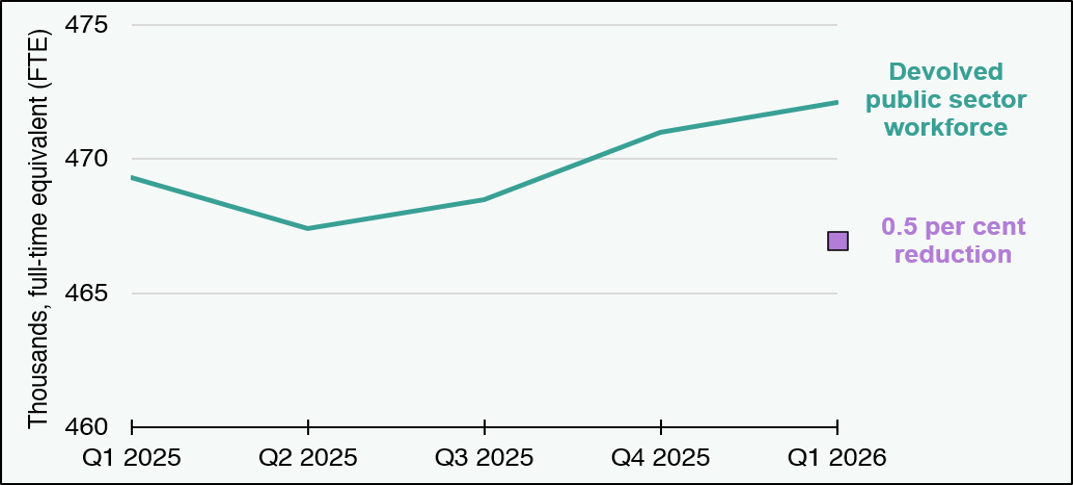
This means that if the overall target is to be achieved over the period to 2029-30, larger reductions will be required from this year (2026-27) onwards. An update about the latest planned profile of workforce reductions alongside the Scottish Budget will be important.
An additional challenge around future workforce plans arises because they were developed alongside pay growth assumptions which may no longer be realistic.
Higher inflation adds pressure to pay
Inflation increases during 2026, largely arising from the escalation of the conflict in the Middle East, have materially altered the pay outlook. Several major devolved-sector pay agreements, including those covering NHS Agenda for Change staff, Police Scotland, ScotRail and the Scottish Prison Service, contain inflation-protection clauses. Rising inflation means these provisions are now likely to be triggered, resulting in larger pay awards than were originally budgeted. In our Fiscal Update, we noted that the Scottish Government estimates this will increase workforce costs by around £43 million in 2026-27 (based on latest inflation data at the time of publication). Moreover, if inflation rises further, these costs could increase beyond current expectations.
The challenge extends into 2027-28. Existing public sector pay policy envisaged maintaining an overall ceiling on pay growth across a three-year period. However, higher-than-expected settlements in both 2025-26 and 2026-27 leave less room for future increases while remaining within those limits. As a result, the Scottish Government faces difficult choices regarding the balance between pay restraint, workforce reductions and service provision when determining future budgets.
There is, however, one potentially mitigating factor. Changes arising from the latest revaluation of public sector pension schemes are expected to reduce employer pension contribution rates from 2027-28. Lower contribution rates should reduce staffing costs across the devolved public sector. While corresponding reductions to UK departmental budgets could lower the Scottish Block Grant funding from the UK Government, Scotland’s relatively large and comparatively well-paid public sector workforce means the savings received may exceed any associated funding reduction. The extent of any savings is still unknown, but it could potentially ease pressures elsewhere in the public sector paybill.
Again, the latest assessment from Scottish Government on public sector pay assumptions underpinning its 2027-28 Budget will be important.
Progress on efficiencies and pay and workforce plans will all be important areas to watch when the Scottish Government presents its 2027-28 Budget in December.