
We have recently published two Insights on Income Tax reconciliations. The first explained the basics of what an Income Tax reconciliation is. The second Insight looked specifically at the reconciliation for 2024-25, based on the Income Tax outturn data published in July 2026.
As explained in those Insights, reconciliations depend not only on forecasts from the SFC, but also forecasts from the OBR. As a result, we have worked with the OBR to publish more in depth information about how reconciliations come about. This article is in our house style and aimed at our audience; the OBR’s equivalent version in their style and for their audience is here.
As a brief reminder, reconciliations correct for differences between forecasts and outturn data – known as forecast error. Funding from Income Tax depends on two factors. First, the funding generated by Scottish Income Tax revenues (SIT), and second, the reduction in funding from the Income Tax Block Grant Adjustment (BGA), based on Income Tax revenues in England and Northern Ireland (ENI). When the Scottish Budget is set, the funding the Scottish Government receives from the UK Government is based on forecasts of SIT by the SFC, and forecasts of the BGA, based on forecasts from the OBR. Once outturn data is available, any forecast errors are corrected through reconciliations.
Why do reconciliations occur?
When SIT outturn exceeds the SFC forecast made at the time the Scottish Budget was set, the Scottish Budget receives more SIT funding than was originally forecast. This contributes positively to the subsequent reconciliation. There is the opposite effect for the BGA, if BGA outturn is higher than forecast then this leads to a reduction in funding to the Scottish Budget and contributes to a negative reconciliation.
The overall size and direction of the reconciliation depends on the interaction of these two effects. We use the term forecast error to describe the difference between our forecast and the final outturn data. SIT and BGA forecast errors in opposite directions will offset each other, while errors in the same direction will add together to create a larger reconciliation.
Reconciliations therefore depend on how correlated SIT and ENI income tax forecasting errors are. This depends in part on the degree of correlation between Scottish and ENI Income Tax revenues. To date, NSND Income Tax outturn data suggests a high degree of correlation of Scottish and ENI revenue growth. [1] That is, when revenues in ENI grow strongly, revenues in Scotland tend to do so as well, and vice versa.
A high degree of correlation in revenue growth suggests that if the Scottish and ENI forecasts are similar this would tend to reduce reconciliations. However, Scottish and ENI revenues are not perfectly correlated, and so including some Scottish and ENI specific factors in the respective forecasts should also help reduce reconciliations.
In practice, this is how SFC and OBR forecasts operate. The OBR primarily focuses on forecasting the whole of the UK in their economy forecasts, and this will be the primary driver of income tax revenue growth in ENI. The SFC makes assessment of Scottish tax revenues, which is informed by forecasts of economic conditions in Scotland and the UK. For the UK outlook, the SFC tends to draw upon OBR assumptions on economic factors such as productivity growth and inflation. For its Scottish forecasts, the SFC then look at Scottish specific factors in areas such as nominal earnings and employment. This should mean a high degree of correlation in our forecasts, but also allows for some regional variation.
SFC and OBR forecast errors and reconciliations
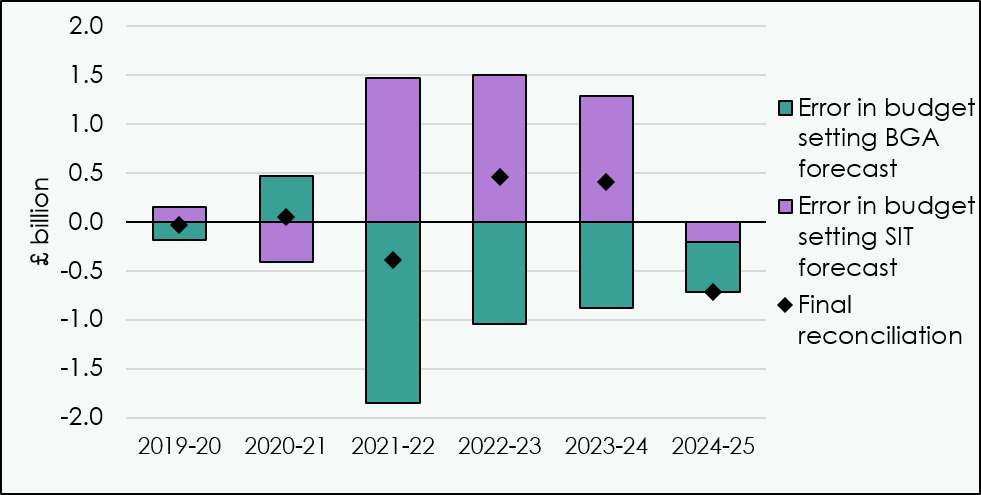
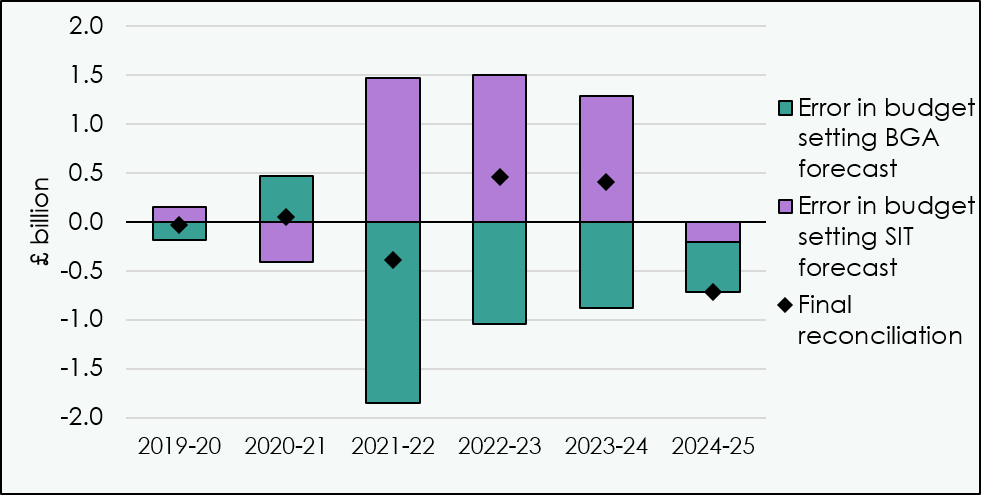
Figure 1 shows that over recent years the differences between our forecasts and outturn have generally been correlated. In five of the last six years, our forecast errors have offset each other to reduce the size of the reconciliation. From 2021-22 to 2023-24 both the SFC and OBR significantly under-forecast SIT and ENI income tax revenues as nominal earnings were higher than anticipated due to the inflation shock caused by the Russian invasion of Ukraine and recovery from the pandemic. This meant that the positive SIT error and the negative BGA error largely offset. As Scotland and ENI are generally subject to the same shocks, this pattern of offsetting errors has been common over the last few years, with SIT and BGA [2] forecast errors since 2019-20 having a correlation of -0.86. [3]
Figure 1: SIT forecast errors, BGA forecast errors and reconciliations
Source: HMRC, SFC, OBR.
However, there is always a risk that the two forecast errors reinforce each other to form a larger reconciliation. This risk has crystallised for the 2024-25 reconciliation. The deduction to the Scottish Government’s funding from the BGA is £512 million larger than was projected, based on outturn for ENI compared to the OBR’s November 2023 forecast. Revenues from SIT are £209 million lower than was forecast at the SFC’s December 2023 forecast. Although these errors are relatively small, they compound to form a projected reconciliation of -£720 million which exceeds the Scottish Government’s borrowing limit.
Differences between forecast and outturn are inevitable in any forecast. The data we have to date show that the degree of correlation in SFC and OBR forecast errors has generally helped to limit the size of reconciliations. However, given the volatility and uncertainty in Income Tax revenue growth in Scotland and ENI, some reconciliations will always occur, and occasionally they will be large. This is an inevitable outcome of the Fiscal Framework.
Previous analysis by the SFC estimated that, if there is an 80 per cent correlation between SFC and OBR forecasts, there is a 24 per cent probability that a negative reconciliation would exceed £600 million. Higher correlations, as we have seen in outturn, will lower the expected size of reconciliations. However, the likelihood that the reconciliation exceeds this is not insignificant, so the negative reconciliation of £720 million should not be unexpected. The Scottish Government must continue to expect and have a plan to manage large reconciliations, both positive and negative.
In addition, the likelihood of reconciliations exceeding the borrowing limit is likely to grow over the coming years. This is because the borrowing limit is uprated by inflation, whereas the forecast errors and therefore the reconciliations are likely to grow with the size of Income Tax. Income tax is likely to grow faster than inflation due to average earnings growing faster than inflation and policies, such as threshold freezes, which have increased the size of income tax in both Scotland and ENI.
The OBR and SFC will continue to work closely together over the coming forecasts to understand the differences between our forecasts and the impact on the Scottish Government’s budget. We comment on our projections for the net tax position in the OBR’s devolved forecasts and the SFC’s economic and fiscal forecasts.
Notes
[1] Adjusting for inflation to remove the impact of significant inflation spikes, and looking at demeaned growth rates, we estimate a correlation coefficient between Scottish and ENI revenue growth of 0.94 – where 1 is perfectly correlated, 0 is no correlation and -1 is perfectly oppositely correlated.
[2] The OBR do not forecast the BGA. However, the OBR forecast ENI NSND income tax which forms the basis of the BGA. This means the ENI income tax difference will be the majority of the BGA forecast difference.
[3] Where 1 is perfectly correlated (i.e., perfectly reinforcing forecast differences), 0 is no correlation and -1 is perfectly oppositely correlated (i.e., perfectly offsetting forecast differences).