
On 9 July, HMRC will publish Income Tax data showing how much revenue was raised in 2024‑25 in both Scotland and the rest of the UK.
The data will be compared against what was originally forecast to be raised in 2024‑25, and next year’s Scottish Budget will be adjusted based on that comparison. The adjustment is called a reconciliation and could add to or reduce funding in the Scottish Budget. In the past we have seen reconciliations ranging from negative £390 million to positive £451 million.
This Insight explains what an Income Tax reconciliation is and what to expect from the upcoming data release. There is a different reconciliation process for the other devolved taxes and social security, which we’ll discuss in a future Insight.
What is a Scottish Income Tax reconciliation?
In short, the Scottish Government’s funding from Income Tax is initially based on forecasts, and the reconciliations process corrects for any errors in forecasts once tax revenue data is available.
In this section, we explain in detail what Income Tax reconciliations are, using the reconciliation for 2023-24 as an example. Figure 1 shows how the reconciliation for 2023-24 came about.
Figure 1: Final Scottish Income Tax and Block Grant Adjustment outturn for 2023-24 compared to budget setting forecasts
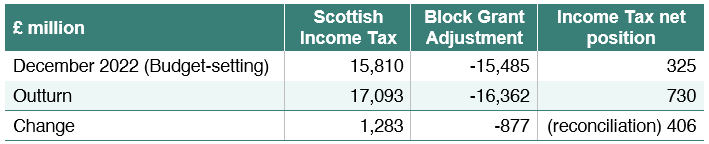
For each Scottish Budget, we forecast the amount of Scottish Income Tax revenues we expect HMRC to collect, and the UK Government transfers that amount to the Scottish Government. In December 2022, for the 2023-24 Scottish Budget, we forecast Scottish Income Tax revenues of £15,810 million.
The UK’s Office of Budget Responsibility (OBR) forecasts the Income Tax revenues HMRC will collect in England and Northern Ireland. These are the basis for the Income Tax Block Grant Adjustments (BGAs), which are funding deductions from the total amount of money the UK Government pays to the Scottish Government (a.k.a. the Block Grant). For 2023-24, the Budget-setting Income Tax BGA was forecast to be £15,485 million.
The amount of funding the Scottish Government received from income Tax (£15,810 million) was greater than the BGA for Income Tax (£15,485), overall contributing £325 million to the Scottish Government’s Budget (the difference between the two). We call this the Income Tax net position.
Once the OBR and our forecasts have been published, these funding amounts are locked at the budget setting values until final data on tax revenues are published by HMRC. Even if later forecasts from us or the OBR point to some forecast error that would change the net position, no action is taken until the final tax revenue data is available.
The Income Tax revenue data we need is only available with a lag of around 16 months. Following the end of a tax-year, taxpayers have until the following January to submit their Self-Assessment returns, and it then takes HMRC a few months to process these returns and finalise its estimates of total tax revenues. For the 2023‑24 tax year, final tax revenue data was published in July 2025.
Once published, Income Tax revenues in Scotland, England and Northern Ireland are known, so final values of Scottish Income Tax, the Income Tax BGA and the Income Tax net position can be calculated.
For 2023-24, both we and the OBR underestimated Income Tax revenues. However, we underestimated Scottish Income Tax revenues by more than the Income Tax BGA was underestimated. Based on HMRC outturn figures, the Income Tax net position for 2023-24 was £730 million, which is £406 million higher than the £325 million suggested by the budget-setting forecasts. In effect, the Scottish Government’s funding in 2023-24 was £406 million lower than it should have been as a result of forecast error. This was corrected through additional funding of £406 million, which was applied to the Scottish Budget for 2026-27. This correction is called a reconciliation.
We have published analysis looking at the likely scale of Income Tax reconciliations. For example, we showed that a negative Income Tax reconciliation exceeding £600 million could occur roughly once every four years.
Income Tax for 2024-25
Back in December 2023 when we published our budget setting forecast for 2024-25, the Income Tax net position was projected to be £1,412 million, based on our and the OBR’s forecasts at the time. The latest available SFC and OBR forecasts at the time of our January 2026 publication suggested a lower net position of £1,102 million, pointing to a negative reconciliation of around £310 million.
Once the final data is published for 2024-25, we will publish an Insight explaining the latest figures and the reconciliation. We are also working with the OBR to produce an Insight exploring Income Tax reconciliations to date and how SFC and OBR forecasts have contributed to these, which we intend to publish later in the summer.