
After the Scottish Parliament approves the Budget, the Scottish Government can change the spending plans twice during the financial year. These updates are called the Autumn and Spring Budget Revisions.
On 24 September, the Scottish Government will publish its Autumn Budget Revision (ABR) 2026-27, the first revision to the current year’s spending plans. The ABR will cover changes to the 2026-27 Budget. It can also be viewed as an early sign of how the Scottish Government plans to manage a much more difficult funding outlook in 2027-28. However, the full picture won’t emerge until after the UK Budget on 28 October and the 2027-28 Scottish Budget on 3 December.
After the ABR is published, the Minister for Public Finance will give evidence to the Finance and Public Administration Committee. This allows MSPs to question the Scottish Government about the proposed changes to spending this financial year. It also provides the Scottish Government with an opportunity to report on progress in achieving its planned efficiency savings in 2026-27.
Improved position for 2026-27
The funding picture has changed since this year’s Scottish Budget was published in January. At that time, funding for public services in 2026-27 was expected to grow modestly, and the outlook for future years already looked challenging. Since then, decisions made by the UK Government have increased the Scottish Government’s funding for 2026-27.
The largest increase came from funding provided to local councils in England to write off historic debts linked to Special Educational Needs and Disability (SEND) services. The Barnett formula means additional spending by the UK Government in England leads to extra funding for the Scottish Government. We estimate that these decisions provide the Scottish Government with an additional £533 million in 2026-27. While there is also extra funding in 2028-29, there is very little additional funding currently expected in 2027-28. This adds to the challenge for the Scottish Government in managing its funding effectively across years.
Figure 1: Additional Block Grant funding from the UK Spring Forecast 2026
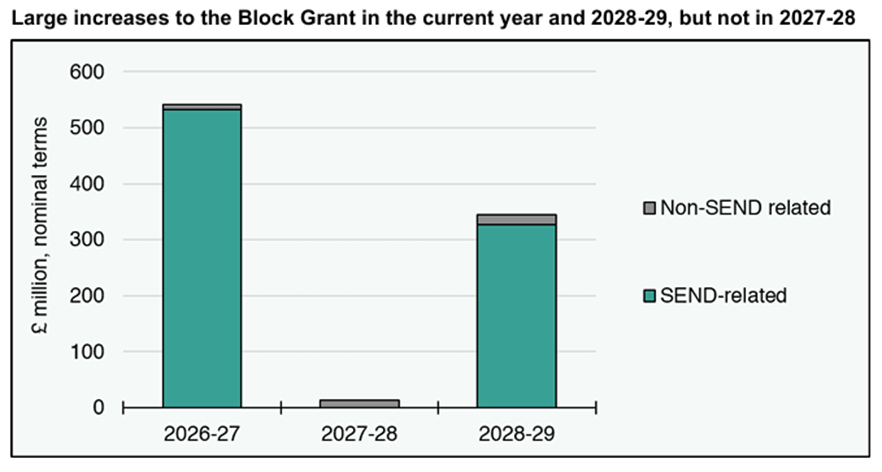
Funding available for day-to-day spending in 2026-27 is now higher than we expected when the Budget was published. Our analysis shows resource funding in 2026-27 now growing by 3.5 per cent in real terms compared with 2025-26. That is a marked improvement on the position facing ministers at the start of the year and provides greater scope to respond to emerging pressures across public services.
The key question will be how the Scottish Government uses this additional funding. It could use the money to address spending pressures that have emerged during the year or support priority services.
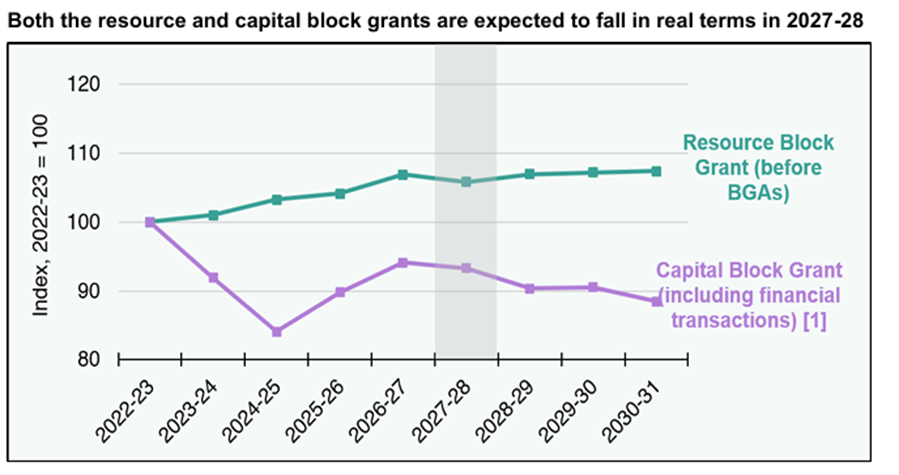
Another option would be to retain some of the funding in reserve for future years. In our recent Fiscal Update we reported that while the current year has become easier to manage, the outlook becomes more challenging in 2027-28.
Figure 2: Resource and capital Block Grant trends since 2022-23
Looking ahead to 2027-28
A key message from our Fiscal Update is that the improvement in funding in 2026-27 does not continue into the following year. As a result, resource funding is expected to fall by 1.2 per cent in real terms in 2027-28. In simple terms, the Scottish Government may have more room to manoeuvre this year, but it is likely to face tighter constraints next year.
The challenge is made greater by a large negative Income Tax reconciliation. Reconciliations adjust the Scottish Budget to reflect differences between what was forecast and what actually happened to tax revenues. In 2027-28, the Scottish Budget will be reduced by £720 million to reflect Income Tax revenues raised in 2024-25.
Although Scottish Income Tax revenues were only slightly below forecast, tax receipts in the rest of the UK grew more strongly than expected. Under the Fiscal Framework, this reduces the funding available to the Scottish Budget. The Scottish Government has some borrowing powers to help manage reconciliations, but the scale of this adjustment is likely to be larger than the borrowing limit. Based on the latest Office for Budget Responsibility forecasts in March 2026, we estimate the borrowing limit for managing the income tax reconciliation in 2027-28 would be £670 million. That is around £50 million less than the £720 million reduction to the Budget.
Capital spending for building infrastructure and other long-term investments also remains under pressure. The UK Government has announced plans to increase defence spending. Because this increase is expected to be partly funded by reducing capital spending by other UK Government departments, we have estimated reductions to the Scottish Government’s capital funding of £70 million in 2026-27 and £87 million in 2027-28. The final impact will depend on decisions in the UK Budget on 28 October.
Pressure remains
Several spending pressures remain uncertain. Inflation has increased since the start of the year, which could increase the cost of public sector pay and the cost of delivering services. There are also questions about whether planned efficiency savings across the public sector can be fully delivered. If these savings are not fully delivered, they could add further strain to future budgets.
Taken together, these factors mean the Autumn and Spring Budget Revisions are about more than changing this year’s spending plans. They are also an opportunity to understand how the Scottish Government plans to manage the fiscal challenges that lie ahead.