

February will be a busy fiscal month. On 25 February, we are publishing a report considering the key challenges facing the next Scottish Parliament, followed by an event the following day at Dovecot Studios in Edinburgh.
It will also be a very busy month in the Scottish Parliament, as MSPs consider the Budget Bill proposals of the Scottish Government for 2026-27. Detailed scrutiny takes place through a 3-stage Budget Bill process. Stage 1 is scheduled for this afternoon, Stage 2 for 17 February and Stage 3 for 25 February. If Parliament agrees, the Bill then receives Royal Assent before the start of the new budget year in April.
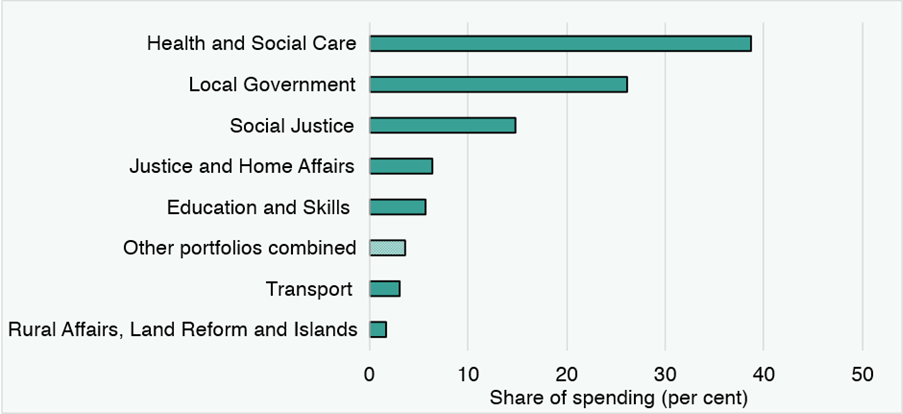
Figure 1 shows the proposed allocations for 2026-27 by Scottish Government portfolio for day-to-day spending covering running costs like staff pay and procuring goods and services. It shows how the 3 largest portfolios of Health and Social Care, Local Government and Social Justice (which includes social security spending) are set to make up around 80 per cent of the total discretionary day-to-day budget.
Figure 1: Portfolio Budget share for day-to-day spending, 2026-27
One issue that has been occupying minds of those considering the Budget for 2026-27 is how comparisons to the Government’s spending plans in previous years are made. What comparison is used, and whether that reflects changes made in‑year between different portfolios is important.
What is the issue with in-year transfers and the Budget baseline?
Before the 2025-26 Budget, the Scottish Government compared spending plans for the year ahead with the plans presented in the previous Budget (Budget to Budget). Therefore, the comparisons were not to the latest position and any in-year changes were not reflected.
Following a recommendation from the Finance and Public Administration Committee (FPAC), in the 2025-26 Budget the Scottish Government presented spending plans compared with the 2024-25 Autumn Budget Revision (ABR). This was a welcome change as it provided a more up-to-date comparison. However, there were issues with comparing budgets on a like for like basis.
This was because the ABR baseline figures for 2024-25 included routine in-year transfers that take place every year (from the area with budget responsibility to the area with delivery responsibility, for example, from health to local government for social care). However, these routine transfers were not reflected in spending plans presented for 2025-26. This meant changes in spending between 2024-25 and 2025-26 appeared too high in some areas and too low in others.
In presenting its spending plans for 2026-27, the Scottish Government has again used the latest in-year position as presented in the 2025-26 ABR as its baseline comparator. In an improvement from last year, however, the Scottish Government has included (‘baselined’) in the 2026-27 Budget some further areas of resource spending that had previously been transferred via the ABR. In total, the Scottish Government has now baselined into 2026-27 around £780 million in resource spending which was transferred between portfolios in-year at the 2025-26 ABR.
However, there are still over £600 million of internal transfers between portfolios contained in the 2025-26 ABR which have not been reflected in the 2026-27 Budget.
Why does this matter?
This has implications for comparing some Budget changes between 2025-26 and 2026-27 for certain key portfolios, in particular Local Government, Education and Skills, and Health and Social Care. Although there are improvements with the social care transfers now baselined into 2026-27 plans, Local Government still had net £476 million added to the 2025-26 ABR baseline, but then these spending lines are shown in different portfolios in 2026-27 plans. This means that any comparisons of spending in the Local Government portfolio for 2026-27 relative to the 2025-26 ABR should be avoided.
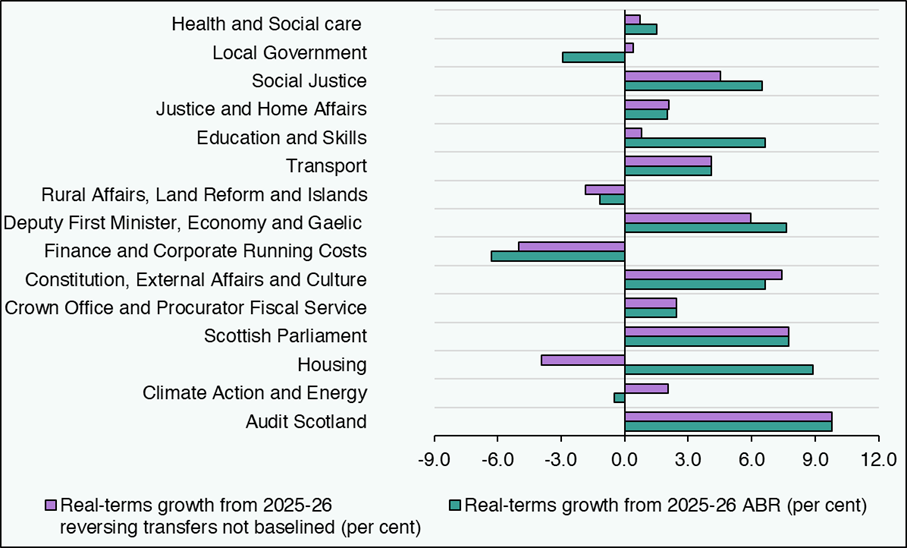
Spending lines and portfolio totals for 2026-27 in the Budget document are presented compared with the 2025-26 ABR, which, as mentioned above for resource spending includes over £600 million of in-year transfers not reflected in the 2026-27 Budget. Figure 2.8 of our recent forecasts highlights the effects on the growth rates for resource spending by portfolio in 2026-27 from comparing to the 2025-26 position with and without these in-year transfers. While this has no effect on portfolios not subject to in-year Budget revisions, it affects most portfolios as shown in figure 2.
Figure 2 shows the effects on the growth rates for resource spending by portfolio in 2026-27 compared with 2025-26 with and without these in-year transfers. Health and Social Care spending grows by 1.5 per cent and Local Government spending falls by 2.9 per cent in real terms in the Scottish Government’s presentation. Comparing spending plans for 2026-27 with the 2025-26 ABR (including the transfers not baselined) provides a more like-for-like comparison. This comparison means that Health and Social Care grows in real terms by 0.7 per cent, and Local Government grows by 0.4 per cent. Together these make up around two-thirds of resource spending
Figure 2: Resource spending real terms percentage change by portfolio between 2025-26 and 2026-27 with and without transfers not baselined
Progress, but more to do
While the Scottish Government has continued to improve the presentation of spending in the Budget including publishing the data showing which transfers have not been baselined, there are still further improvements to be made. We continue to recommend that all routine Budget transfers should be contained from the outset in the spending portfolio to which they will ultimately move.
In its final report on the Budget, FPAC made the following recommendation:
“The Committee therefore recommends that the Protocol currently under negotiation between the Scottish Government and SFC is updated to include agreement on how regular in-year transfers should be presented, in time to be implemented in the Scottish Budget 2027-28.”
Baselining all regular in-year transfers will allow Parliament to have a clearer understanding of changes to Budget lines when it considers the Budget Bill in future.